June 1, 2015

5/19/15 - A Book Written By Someone Under 30


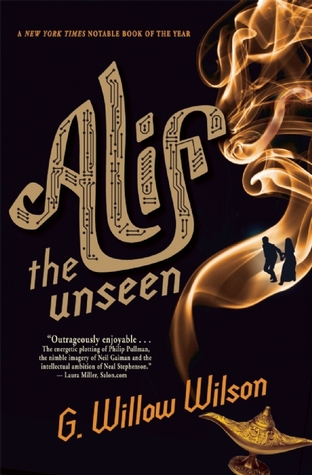
This is the book I finished on the airplane ride home from Paris! I would say it has good associations now, but that was a nightmare of a homecoming, so... there are no good associations. Except for the delicious bagel I got the morning of the second day of flying, and even that is clouded over by the fact that the airport milk I got was bad... so disappointing. Thankfully, Alif the Unseen, the book for the Book Written By Someone Under 30 challenge, is good enough to provide plenty of good associations on its own.

Go read the Goodreads snippet, if you don't already know what the gist of the story is. Because I, for sure, cannot sum it up myself in a way that would do it any justice. Middle Eastern unrest, a clever yet impossibly lame hacker for an MC, something like One Thousand and One Nights, actual jinn and their supernatural habitat, the mingling of technology and magic! Not to mention fantastically drawn characters! What is there not to love about this story?

I gave it a solid 4.5 on Goodreads, which echoes another recent 4.5 - A Darker Shade of Magic. The two stories give me a lot of the same feelings - there wasn't the emotional depth that would have otherwise catapulted these two books into a full 5 stars, but they have everything else. The writing is not flowery or purple, but it's beautiful, expressive and magical without sacrificing coherency; the characters flow over their stereotypes to become heroes you really, really root for; both authors excel at mingling magic with a sense of the Real World. 

Alif comes with the added bonus of truly beautiful musings on religion. The religion of choice is, of course, Islam; however, like any story with a decent perspective on religion, there are moments specifically for adherents of Islam (a lot rests on the translation, or inability thereof, of the Qu'ran) and there are moments for everyone who believes in a higher spiritual power or deity. And what beautiful moments Wilson gives. They made my brain purr.

This is an adult book (often classified, mistakenly, as YA) and for that reason I would warn younger/more sensitive readers of some brief sensual scenes and strong language, but, seriously, if there's any chance of you not being disturbed by these things, read this book. If there's any more adulty book that you read, it should be this one. 

May 28, 2015

5/5/15 - An Author I Love


Jodi Lynn Anderson is the kind of author that I trust. While she has never done anything truly mindblowing on the level of, say, Markus Zusak, she writes well and consistently. My personal favorites were her middle-grade May Bird series, but there was also Tiger Lily which I have wanted to reread almost since I finished reading it the first time.

May Bird being other-world fantasy, and Tiger Lily being glorified Peter Pan fanfiction, these of Anderson's offerings made me used to her fantastical side. Peaches takes up on the more realistic side, though the peach orchard that the novel's three protagonists - Leeda, Birdie, and Murphy - inhabit for a while might be more magical than even Neverland. 

From the very first page, it's made apparent that Peaches is a novel for a slightly older teenage audience. The situations are more mature, but more than that, Anderson's style is more mature. It's solid and dependable with just the sweetest, slightest hint of magic - a lot like the story itself. Her characters are... they're basically flawless. I went from feeling meh about all three of them to rooting for them to live together forever, on the peach orchard, happily ever after, please.

It wasn't quite that simple, of course, but I still loved where the story went. It was meandering but not pointless, a little circumstantial but never in a way that made me want to suspend my suspension of disbelief. Anderson executed a balancing act that deserves applause and frequent return trips. And there are sequels!

4/29/15 - A Play/A Book That Made Me Cry


The reading history log for the last week or so of April and the first week or so of May is... patchy, to say the least. Sometimes I never even finished filling in my reading goals for the week all the way. The 23-29 week of April only has three books in it, and only two of those were read. Fortunately, those two were Challenge entries!

I used up another easy out that week - A Play. Plays are incredibly short, they should be easy to understand, and did I mention that they're short? Not to mention that The Children's Hour by Lillian Hellman was made into a movie starring Audrey Hepburn. My favorite actress ever. So I'd been meaning to read this one for a while.

The gist of the play is that a boarding-school brat starts a rumor that her two headmistresses are engaged in lesbian activity. In the... 40s? As you can imagine, it's not a happy play. 

It's an engaging one, though. The characters owned their voices, and while it takes a little while to distinguish the generic WWII women's names in your head, you get there eventually. It helps that Hellman manages suspense and especially dialogue really, really well. You love who you're supposed to love and you hate who you're supposed to hate, with equal and opposite passions. 

It makes the ending worse, being so fond of the characters. The whole play is suffused with a sort of sadness - which makes sense; it's a suitable sadness, which still doesn't take away from the effect it's supposed to have. 

Not a play for everyone - the ending is deeply disturbing - but a good one. If you can handle it, I'd recommend it. I know, now that it's been a few weeks, that I'm ready to watch the Hepburn movie.


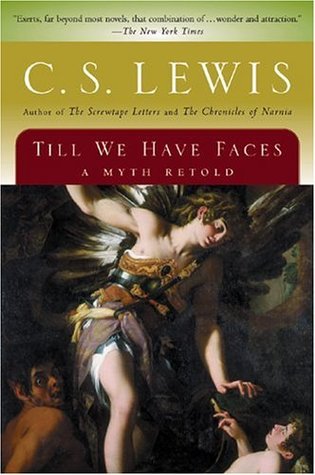
And we have A Book That Made Me Cry. Is it cliché that this is one of my very favorite novels - possibly my favorite standalone story? If it is, I don't care. Faces is worth it.

If you don't know the story of Till We Have Faces, don't read a summary. Just go get it and read it. Don't even glance at the back blurb. Just read it. All you need to know is what's on the front cover: there is a lot about faces, it's a myth retelling, and C.S. Lewis wrote it.

But this is not the Lewis of Narnia; this is not the Lewis of Screwtape; this is not the Lewis of radio broadcasts about Christianity. This is a wholly separate Lewis, approaching the divine with nearer a divine sense than Aslan got in all seven books. (Not to disparage Narnia; I, like almost every other homeschooler, have a deep sycophantic love for Narnia. But Faces is different.)

Do you like flawlessly, lovingly crafted and handled female protagonists? Do you like tangles upon tangles of emotional, spiritual, and religious questions, woven and punched together until the mass is almost too heavy for your heart to bear? Do you like having your carefully cradled beliefs and notions about gods and humans pierced by arrow after unerring arrow of honesty and doubt? Do you like knowing that the divine is unknowable and that the fault is not in our stars but in our unimaginable smallness and unimportance? Do you like being told that despite our unimaginable smallness and unimportance that something too big for us to ever comprehend exists for us and watches over us in our unimaginable lives?

If so, read Till We Have Faces. If not, read Till We Have Faces. There's something unspeakably freeing about having your insignificance articulated in this way. It's cathartic. I recommend Faces every six months to deconstruct any sense of pride or bigness that you might think about cultivating - in case you make Orual's mistake of writing a book.

April 30, 2015

4/22/15 - A Book Based On Its Cover

I'm using up all of my "get out of limbo free" cards, but this one was definitely worth more than the last one!


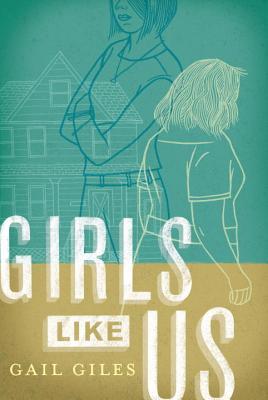
Girls Like Us was more of a wild card than Guy In Real Life. The cover isn't that descriptive, and neither is the title. I'm still trying to figure out why I picked it up. Maybe because it was small.

It is a short, tidy little book that I read in a little over an hour, all told. It is not a tidy story, as I found out, and as you can find out with a quick glance at its Goodreads description.

Quincy and Biddy are both graduates of their high school’s special ed program, but they couldn’t be more different: suspicious Quincy faces the world with her fists up, while gentle Biddy is frightened to step outside her front door. When they’re thrown together as roommates in their first "real world" apartment, it initially seems to be an uneasy fit. But as Biddy’s past resurfaces and Quincy faces a harrowing experience that no one should have to go through alone, the two of them realize that they might have more in common than they thought — and more important, that they might be able to help each other move forward.

I've never had experience with the kind of situation that Giles describes from the perspectives of Biddy and Quincy, and I don't know of any first- or secondhand knowledge that Giles might have, so I don't know how much justice she does to this kind of story. But from a purely storytelling perspective, Giles does not do too badly. There's an interesting tension between the two leads, and there are enough divergences from cliche that made me keep reading when I might have gotten bored instead. There are plenty of conversations that highlight all sorts of social issues - race, class, education, even a couple gender conversations. Nothing felt overly heavy-handed (a little bit, but not overly), and the characters are well-drawn enough to make the conversations unbiased.

What isn't balanced or well-drawn is Giles's attempts at writing voice. As other reviewers have noted, Biddy and Quincy have almost exactly the same voice, especially at the beginning, when readers have to distinguish two first-person perspectives right off the bat. It's not just that they have the same sort of thoughts, it's that they have almost the same accents. Maybe that's how it works in Texas, but it seems unlikely. It's jarring sometimes and I often had to check back to chapter headings multiple times to remember who was talking.

Another warning: there are pretty intense and explicit descriptions of and conversations about rape/sexual abuse. Seriously. Young readers and people sensitive to this should probably not read Girls Like Us.

Flaws taken into account, I did enjoy Girls Like Us. It was, for all its bleak situations and character development, an oddly charming little story about three women coming together as the kind of family they need. I do recommend it, with significant reservations.

4/15/15 - An Author I've Never Read

Let's do the catch-up game one more time...


One admission out of the way: I am not a gamer. I am also not a not-gamer. I like games like some people like The Golden Girls. They're fun and have a limitless short-time obsession factor, but I'm not selling my soul to them, nor am I going to spend a lot of time on them after a month or two. Or money.

So this was a bit out of my range of experience. These aren't even my kinds of games - I'm an uber-lite gameplayer, along the lines of Zelda and Sonic. I've never played an MMORPG (unless DragonFable counts?) and I've always been terrified at the idea of participating in a game like D&D - too much passion and movement, too few guidelines. I like Mario Kart, where you have a designated track which you have to make your way around a set amount of times with what comes down ultimately as the most superior sense of efficiency. It's great. But I digress.

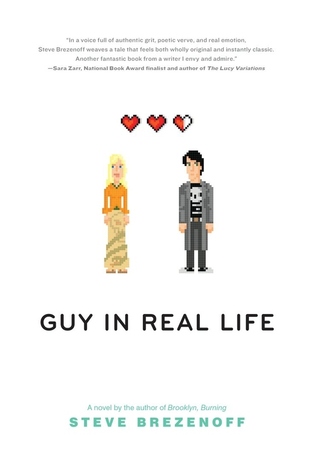
Actually, that's a sign. I'm way more into talking about how Mario Kart is exactly my type of game than I'm into talking about the book I'm supposed to be reviewing. It's not that Guy In Real Life is a bad book, per se. It's just... not a good one, either.

It's the classic story of "a guy and a girl from two very different lifestyles have a meet-cute(-but-awkward-too) and then end up falling in love through various quirky incidents that shift up and down the scale of believability." It's so classic that I was bored. It's a constant set-up of "obstacle - obstacle hurdled" repeated until the book ends, with a bizarre obstacle that was basically every 90s/early 2000s parent's worst chatroom nightmare.

Boy has a weird, not-very-friendly friend who's super into something the way Boy is into Girl? Check. Girl has a cast of cardboard, often pointless friends who don't like Boy? Check. Girl has another suitor who goes toe-to-toe with Boy? Check. It's all so generic. While Svetlana did have something of a unique voice, she came off a lot as obnoxious rather than individualistic, and I don't even know what was going on with Lesh.

I'm bored just talking about it. It's not as much rage-fuel as a John Green book but that just makes it drab to talk about. Two stars, find some other, actually quirky contemporary teen romance.

April 8, 2015

4/8/15 - A Memoir

This review is actually for last week's book, which I didn't get to because of extenuating circumstances. And that's my excuse for not having a review for this week - homework. Forgive me. Just when I was caught up, right? Oh, well. Summer break is coming.

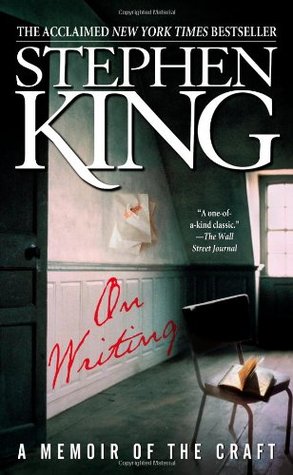
But last week, I was successful, with both completing the book and enjoying it. Behold: my review of the inimitable Stephen King's On Writing.


Before I dive into the review, I should admit that I have only read one piece of King fiction before, and that's not even one of his horror ones: it was The Dark Tower, which I enjoyed greatly despite being really confused. I've read more Stephen Lawhead than Stephen King - perhaps a crime, perhaps not.

But I am a huge fan of King himself, and his attitude towards writing. He's hilarious, for one thing - don't let the horror thing scare you away. He's a witty guy. I had to put the book down a couple times to laugh (the poison ivy, oh my gosh).

But more than that, he's experienced. He's got a lot of disappointment and success and years under his belt. It doesn't matter that I don't gel with 100% of his opinions on writing and the writing process; I still have to respect them, because he has for sure been doing something right. He doesn't command respect, but you can't help but give it to him, reading this book.
He's also genuine. Any writer that doesn't let you in on the hardships that come with fiction-writing are selling you something, and King never does this. He's truthful, and his transparency makes this easy to read, both physically and spiritually, if that makes sense.

If you're a writer, please read this (unless language really bothers you/would distract from his message). Just to know the experiences of an author who's more experienced than 95% of us writers-to-be ever will. And if you're not a writer, why not read it anyway? It's relatively brief, and if you want some King context, it'll be fun. I don't know any reason (besides the language, for my more sensitive audiences) why I wouldn't recommend this to anyone. 

March 26, 2015

3/26/15 - Number In The Title/Banned Book

And I unexpectedly make up for the time I lost, aided (for once) by a college class!

This week I decided to read Boy21 by Matthew Quick for my Book With A Number In The Title challenge, but what I had forgotten was that back in 2014, I had chosen Brave New World for my Banned Book challenge. And as it turns out, Brave New World was this week's assignment for my Secondary Worlds course! So the week that I dropped will be rectified now.


Boy21 was an oddity for me, even more than All The Bright Places (gah, that title). For one thing, not only is it a contemporary fiction thing with an undoubtedly "quirky" premise (boy with problems makes friends with another boy with even worse problems), it takes place against a solid backdrop of sports. Gasps from the audience.

But I'd seen good reviews (not like there aren't good reviews for Paper Towns, Collin, geez), and I'm always up for a good bromance, so I tried it.

In short, it was good. It wasn't anything particularly groundbreaking, though it easily could have been. It could have been anything, and therein, I believe, lies its problem. It could have been anything and it couldn't decide what. A black/white racial critique? A black/Irish critique? A friendship story? A mob story? A psychological story? A romance? A coming-of-age?

And there's nothing at all wrong with trying to tackle more than one of these issues, even all of them. Boy21 had huge potential, and I think Quick could have done a lot with it if he had expanded the story by 150 or 200 pages. As it is, it's a very slim, large-printed book of 250 pages (50,000 words, perhaps) and it just doesn't get into anything very deeply.

The titular character, Boy21 (or Russ), alone has so much potential - murdered parents, an obsession with space, the insistence that he's from "the cosmos," his relationship with the narrator, Finley. But none of it is ever explored. It's just explained. Same with Finley's backstory; his issues are narrated mostly through voiceover and exposition, all at the very end of the story. His relationship with Erin is even more truncated; all of the relationships are, really. And so are the social issues - the racial and ethnic tensions, the urban commentary, the educational/sports problems. These things are introduced and then never quite developed.

It ends as obscurely as it begins, but less satisfactorily. It's enjoyable, and it's not that Quick can't write. The plot progression was just... less than stellar. Or maybe I was just expecting too much. As it is, Boy21 felt like a fragment more than a fully-realized story.


Brave New World marks my first foray into classic dystopia, which is really pretty scandalous. I wish I had liked Huxley's work more.

I have to get the positive out of the way first, though. It's an incredibly balanced viewpoint. What you get out of dystopias now - the subgenre of "white girl saves the world" stories - tend to have very firm ideas on What Society Should Be. And that's all well and good, but it makes dystopia lean more towards fantasy than social commentary, which seems to be how dystopia started. And I have to say that while I find absolutely no problem with genres changing and shifting over time according to what the authors want to write, I think I like the complexities of Brave New World over the more cut-and-dry worlds of whatever "stick it to the Man" stories end up on Books-a-Million front shelves.

And anyway, Alpha-Pluses are an absolute dream after mother-hugging Dauntless (excuse my French).

There are no good guys in Brave New World. John is set up as one but even he can't resist the effects of conditioning, even if his conditioning was self-inflicted and "alternative." Even Shakespeare (may he rest in highest peace) is not suitable for basing a morality system upon. Anyway, with no good guys, it's hard to say where Brave New World comes to in the end.

It's really a system that, as my lit professor said at the end of the class, is hard to object to, once you're in it. And that really makes it infinitely more terrifying than any Capitol or whoever the fudge was in charge of Chicago or any of the vaguely American hotspots in White Girl Saves The World stories.

I didn't like Brave New World. But I was impressed by it. It's a hard story to ignore. When you have a story where there are no good alternatives, just as there are no good characters, it makes you think a bit harder.

March 22, 2015

3/18/15 - Based On/Turned Into A TV Show, and the February Book

I made up for last week by reading not one but two Challenge book! One for the 2015 Challenge, and one for the New Book Every Month thing. I present: A Book Based On or Turned Into a TV Show, and a Book Published In February 2015!


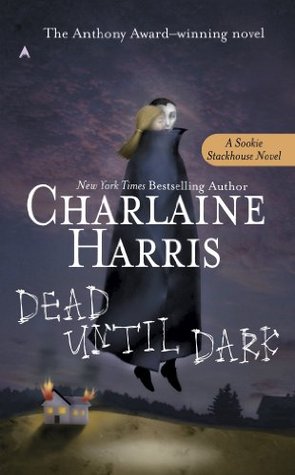
Dead Until Dark has always sounded sort of like a bridge between the less-modern classics of Anne Rice and the super-modern classics of Twilight. Less class than the former, but still more than the latter - you know what I mean?

And though I've not yet read any Anne Rice (it's on my list), I can definitely say that it did have a bit more - not much, but more - than Twilight. For one thing, it's set in Louisiana! The south! My homeland! Sort of. Not really, but close enough for the setting to feel real familiar. 

Though this only ended up with three stars on my Goodreads account, I can say that it was a high 3. Maybe somewhere like a 3.5? Mostly because of sheer comparative value. Sookie is, compared with 99% of the paranormal heroines I've read about, is an incredible person. Almost every situation that your average contemporary YA heroine is faced with is in this book, and Sookie pretty much turns every cliché response on its head and actually is... really, really intelligent, most of the way through. At least in comparison to most vampire lovers. AND THERE IS AN ACTUAL PLOT WITH ACTUAL CONFLICT. I almost cried when I realized that what we had here was an honest-to-gosh problem and real live issues instead of some cockamamie fabricated bullcrap. It was beautiful.

Does all this have something to do with the fact that this is adult fiction written about a decade ago and not current YA? Probably. Does this mean that the reason I really appreciate this book is probably not quite valid? Almost certainly. Does it make me like Sookie Stackhouse any less, or make me want to read the next books any less? Frick no. I'm on the Sookie bandwagon at this point. Bring on the rational decision-making and the Honest-to-Gosh Conflict.

Note: Dead Until Dark is an adult book and I would not recommend it to any younger readers who would be sensitive to adult content/a bit of adult language.


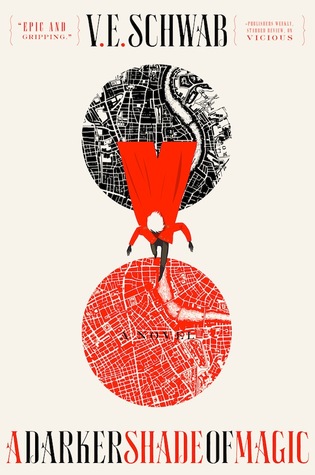
For the February Book, I managed to snag A Darker Shade of Magic, and it is absolutely one of the best decisions I've made this year in regards to reading.

A Darker Shade of Magic splits the difference perfectly between old and new, unique and timeless. There are original systems of magic, and there's the plucky streetwise girl-thief who wants to become a pirate. (She is, however, a wonderful character, not at all like her description makes her out to be, and I liked her almost as much as the male MC.) There are also some pretty despicable but interesting villains, as well as relationships that are frankly beautiful and I hope dearly that they get some fleshing out in the continuing books.

One of the greatest things about A Darker Shade of Magic is the fabulous pacing. Schwab can write very well but she also structures this book intelligently: it's broken up into almost 20 different "parts," with relatively short chapters between them. Like I said in my Goodreads review, it's like Max Ride with quality - it's a normal-sized book for adult fic, but the short chapters and parts make the story whizz by, especially aided by the fantastic pacing outside the technical structure.

A Darker Shade of Magic is a huge success. Please go out and read it right now.

Note: This is also an adult book and while there are not as many adult situations there is still a bit of adult language. Not that much, though. Three or four instances.

3/11/15 - Oops.

The week of March 5th-11th was a bit crazy, which is ironic because it was spring break. But when it's spring break, I did everything but read, basically. I finished one book, which was for my philosophy class, and I'm not going to shoehorn that into one of the categories for actually fun books.

So I'll catch up on this one some other week. Surely it can't be that hard, can it?

4/3/15 - A Book of Short Stories

(We're going to pretend that these were also written on time. Thanks.)

For the first Challenge book of the rainy month of March, we're going with a classic - A Good Man Is Hard to Find by the inimitable Flannery O'Connor.


There's really not much to say about O'Connor's writing. If you've read it, you know what it's like; if you haven't, there's no way to describe it. Her stories are sparse, minimalistic, almost inconsequential. A lot of them are almost impossible to pick out meanings for. But they are hugely powerful. Her control of language and characters is frankly astonishing. And the way she draws you in, half by enchantment and half by revulsion, is... honestly, I can't think of anyone who has ever done the like.

Some of O'Connor's best stories are in this edition, such as the title story and "The Life You Save May Be Your Own" and "Good Country People." My personal favorite was "The River," which was not quite as opaque and difficult as some of the others, but still so incredibly punch-to-the-gut. I've loved her work ever since I read "A Good Man Is Hard To Find" about two years ago, though this is the first full collection of stories I've read by her. I'm glad to report that the majority of her work is equally fantastic.